About this ebook
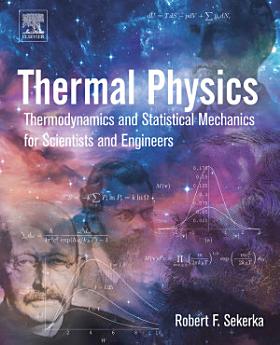
In Thermal Physics: Thermodynamics and Statistical Mechanics for Scientists and Engineers, the fundamental laws of thermodynamics are stated precisely as postulates and subsequently connected to historical context and developed mathematically. These laws are applied systematically to topics such as phase equilibria, chemical reactions, external forces, fluid-fluid surfaces and interfaces, and anisotropic crystal-fluid interfaces. Statistical mechanics is presented in the context of information theory to quantify entropy, followed by development of the most important ensembles: microcanonical, canonical, and grand canonical. A unified treatment of ideal classical, Fermi, and Bose gases is presented, including Bose condensation, degenerate Fermi gases, and classical gases with internal structure. Additional topics include paramagnetism, adsorption on dilute sites, point defects in crystals, thermal aspects of intrinsic and extrinsic semiconductors, density matrix formalism, the Ising model, and an introduction to Monte Carlo simulation. Throughout the book, problems are posed and solved to illustrate specific results and problem-solving techniques. - Includes applications of interest to physicists, physical chemists, and materials scientists, as well as materials, chemical, and mechanical engineers - Suitable as a textbook for advanced undergraduates, graduate students, and practicing researchers - Develops content systematically with increasing order of complexity - Self-contained, including nine appendices to handle necessary background and technical details
In Thermal Physics: Thermodynamics and Statistical Mechanics for Scientists and Engineers, the fundamental laws of thermodynamics are stated precisely as postulates and subsequently connected to historical context and developed mathematically. These laws are applied systematically to topics such ...
About the author
Robert Floyd Sekerka is University Professor Emeritus, Physics and Mathematics, Carnegie Mellon University. He received his bachelor's degree summa cum laude in physics from the University of Pittsburgh in 1960 and his AM (1961) and PhD (1965) degrees from Harvard University where he was a Woodrow Wilson Fellow. He worked as a senior engineer at Westinghouse Research Laboratories until 1969 when he joined the faculty of Carnegie Mellon in the Materials Science and Engineering Department; he was promoted to Professor in 1972 and was Department Head from 1976–82. He served as Dean of the Mellon College of Science from 1982 through 1991. Subsequently he was named University Professor of Physics and Mathematics with a courtesy appointment in Materials Science and Engineering. He retired in 2011 but continues to do scientific research and writing. He is a Fellow of the American Society for Metals, the American Physical Society, and the Japanese Society for the Promotion of Science, and he has been a consultant to NIST for over forty years. Honors include the Phillip M. McKenna Award, the Frank Prize of the International Organization for Crystal Growth (President for six years) and the Bruce Chalmers Award of TMS. Please see http://sekerkaweb.phys.cmu.edu for further information and publications.
Robert Floyd Sekerka is University Professor Emeritus, Physics and Mathematics, Carnegie Mellon University. He received his bachelor's degree summa cum laude in physics from the University of Pittsburgh in 1960 and his AM (1961) and PhD (1965) degrees from Harvard University where he was a Woodro...
Rate this ebook
Tell us what you think.
Reading information
Smartphones and tablets
Install the Google Play Books app for Android and iPad/iPhone. It syncs automatically with your account and allows you to read online or offline wherever you are.
Laptops and computers
You can listen to audiobooks purchased on Google Play using your computer's web browser.
eReaders and other devices
To read on e-ink devices like Kobo eReaders, you'll need to download a file and transfer it to your device. Follow the detailed Help Center instructions to transfer the files to supported eReaders.