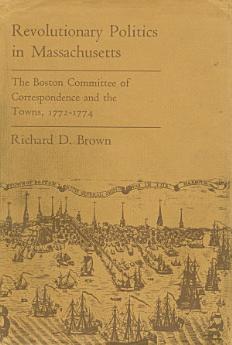
Revolutionary Politics in Massachusetts: The Boston Committee of Correspondence and the Towns, 1772-1774
Nov 1970 · Harvard University Press
Ebook
298
Pages
Tools
info
About this ebook
More than a century and a half ago, John Adams urged scholars investigate the communications of the Boston Committee of Correspondence, the most radical and important of the revolutionary committees of correspondence. Such a study, Adams suggested, would reveal the underlying impetus of the revolutionary movement. Now, for the first time, Richard D. Brown has made an exhaustive and systematic analysis of the committee that set a pattern for America and for the world by keeping alive the revolutionary spirit at a time when the issues were cloudy and public interest was dormant.
The Boston committee, organized to arouse the people of Massachusetts and to inform them of their rights, initiated the use of local committees of correspondence and went on to become a major revolutionary institution which helped bring about fundamental changes in Massachusetts politics. Mr. Brown's book focuses on the years 1772 to 1774, when the inhabitants of Massachusetts moved from quiet accommodation with the British imperial system to massive rebellion against it. His investigations of the records of the Boston committee and of voluminous town records never before studied have resulted in a revision of previous interpretations regarding the interaction between leaders in Boston and the people in the towns.
The author's findings indicate that the Boston committee did not control Massachusetts political action, manipulating the political behavior of the towns, as earlier theorists have suggested. Though Boston was a leader, the towns generally acted independently, and government by consent developed effectively on the local level. The letters which passed between the capital and the countryside reveal an expanding political consciousness and an ever-increasing political sophistication at the grass-roots level. They articulate an essentially radical view of politics based on popular sovereignty.
As an account of the process of political integration among a colonial people engaged in an independence movement, this book will appeal not only to historians but also to political scientists concerned with the emerging nations of the twentieth century.
More than a century and a half ago, John Adams urged scholars investigate the communications of the Boston Committee of Correspondence, the most radical and important of the revolutionary committees of correspondence. Such a study, Adams suggested, would reveal the underlying impetus of the revol...
About the author
Richard D. Brown is Board of Trustees Distinguished Professor of History, University of Connecticut, and Director, University of Connecticut Humanities Institute.
Richard D. Brown is Board of Trustees Distinguished Professor of History, University of Connecticut, and Director, University of Connecticut Humanities Institute.
Rate this ebook
Tell us what you think.
Reading information
Smartphones and tablets
Install the Google Play Books app for Android and iPad/iPhone. It syncs automatically with your account and allows you to read online or offline wherever you are.
Laptops and computers
You can listen to audiobooks purchased on Google Play using your computer's web browser.
eReaders and other devices
To read on e-ink devices like Kobo eReaders, you'll need to download a file and transfer it to your device. Follow the detailed Help Center instructions to transfer the files to supported eReaders.