About this ebook
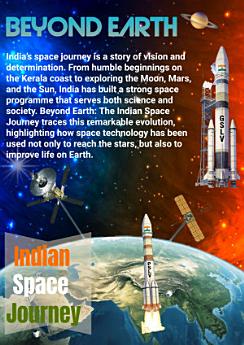
The book follows the story from the pioneering ideas of Dr. Vikram Sarabhai and the creation of INCOSPAR and ISRO to early achievements like Aryabhata and SLV‑3, and then to major satellite and launch‑vehicle families such as INSAT, IRS, PSLV, and GSLV. In clear, accessible language, it explains how these systems support communication, weather forecasting, education, resource mapping, disaster management, and navigation for millions of people in India and beyond.
Later chapters explore India’s landmark science and deep‑space missions—including Chandrayaan, the Mars Orbiter Mission (Mangalyaan), AstroSat, Chandrayaan‑3, and Aditya‑L1—showing how the country moved from using space technology to actively exploring the Moon, Mars, and the Sun. Designed for general readers and students, this book offers an engaging overview of India’s extraordinary journey beyond Earth and the ways space technology continues to shape life on the ground
Ratings and reviews

- Flag inappropriate

- Flag inappropriate

- Flag inappropriate
About the author
Roots of Inspiration
I am Ravi G, a graduate in Information Technology with an ITI qualification in Electronics, and a banking professional with more than 22 years of experience at City Union Bank (CUB). My connection to India’s space story, however, began at home. My father, Late Sri A. Gopala Iyer, served in the Indian Space Research Organisation (ISRO) for over three decades.
During my childhood, he often spoke about ISRO’s missions, scientists, and the quiet dedication behind India’s space programme. Those conversations filled me with curiosity and pride, and taught me that India’s journey into space is not only about rockets and satellites, but about vision, discipline, and service to the nation.
Guided by those early memories, and drawing on my technical background and interest in science and history, I have written Beyond Earth: The Indian Space Journey. With the help of modern tools and artificial intelligence, I have tried to present India’s space story in a simple, accurate, and accessible way for general readers.
This book is both a tribute to the pioneers of India’s space programme and a personal reflection of the inspiration I received at home. I hope it deepens readers’ appreciation of ISRO’s remarkable journey and encourages future generations to look beyond Earth with curiosity and confidence.