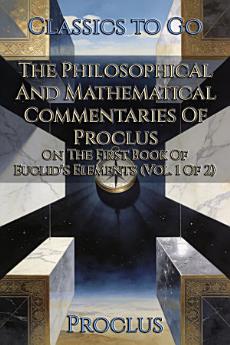
The Philosophical And Mathematical Commentaries Of Proclus: Restored Classics to Go Edition

· Otbebookpublishing
Ebook
464
Pages
Eligible

About this ebook

This learned and reverent work gathers Proclus's commentary on the first book of Euclid's Elements with related Platonic and theological writings, presenting geometry as far more than a practical art. Here mathematics becomes a ladder to wisdom: a discipline that trains the mind for contemplation, leads beyond the material world, and opens onto the deepest truths of Pythagorean and Platonic philosophy. The translator's preface stresses the difficulty of the Greek, the shortcomings of the surviving text, and the value of rare Latin help, framing the translation as a careful act of preservation for discerning readers. At its heart, the book mounts a passionate defense of ancient philosophy against modern experimental science, insisting that truth lies in first principles, virtue, and the perfection of the soul, not merely in instruments or usefulness. It develops a metaphysics of Ideas, universals, number, unity, limit, and infinity, arguing that stable forms must precede changing particulars and that the order of nature reflects a divine intellect. Through discussions of the heavens, living beings, and divine foreknowledge, it offers a majestic vision of reality as an intelligible, eternal, and divinely ordered whole. This edition has been fully restored with modern typesetting, custom cover design.
This learned and reverent work gathers Proclus's commentary on the first book of Euclid's Elements with related Platonic and theological writings, presenting geometry as far more than a practical art. Here mathematics becomes a ladder to wisdom: a discipline that trains the mind for contemplation...

About the author

Proclus, who lived from 412 to 485 CE, was one of the great late antique philosophers and the last major head of the Platonic school at Athens. Born in Constantinople and educated in Alexandria and Athens, he became a towering figure in Neoplatonism, combining rigorous philosophical inquiry with a deep reverence for mathematics, theology, and the ancient intellectual tradition. His writings helped preserve and systematize Greek philosophy at a time when the classical world was changing rapidly, and his commentaries on logic, metaphysics, and mathematics reveal a mind determined to show the underlying order of reality. He is especially admired for the way he brought together philosophy and geometry, treating mathematical reasoning not as a dry technical exercise but as a path toward truth, harmony, and the structure of the cosmos. Across his work, central themes include the unity behind multiplicity, the ascent of the soul, the relation between reason and the divine, and the belief that careful study can reveal beauty and meaning in the world. These ideas still matter today because they speak to modern concerns about knowledge, spirituality, and the search for coherence in an often fragmented age. Proclus's legacy endures in the history of philosophy, the transmission of classical thought, and the long tradition of reading mathematics as intellectually and spiritually illuminating. Readers who enjoy philosophy, the history of ideas, classical learning, or the deep connections between mathematics and metaphysics will find him especially rewarding.
Proclus, who lived from 412 to 485 CE, was one of the great late antique philosophers and the last major head of the Platonic school at Athens. Born in Constantinople and educated in Alexandria and Athens, he became a towering figure in Neoplatonism, combining rigorous philosophical inquiry with ...

Rate this ebook

Tell us what you think.

Reading information

Smartphones and tablets
Install the Google Play Books app for Android and iPad/iPhone. It syncs automatically with your account and allows you to read online or offline wherever you are.
Laptops and computers
You can listen to audiobooks purchased on Google Play using your computer's web browser.
eReaders and other devices
To read on e-ink devices like Kobo eReaders, you'll need to download a file and transfer it to your device. Follow the detailed Help Center instructions to transfer the files to supported eReaders.