About this ebook
Read that twice and you have the problem this book poses. The charm was genuine. So was the cross. Plutarch is not building a case for or against a tyrant. He is assembling a man, and the man he assembles keeps doing two things at once.
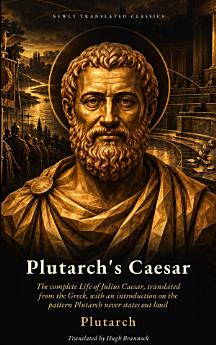
This is the complete Life of Julius Caesar as Plutarch wrote it: the boy who wept in Spain over Alexander's achievements because at the same age he had done nothing of note, the commander who halted at the Rubicon and went back and forth in his reasoning before crossing, the victor who was delighted to find Brutus alive after Pharsalus and handed office to the men who had fought him. Then the diadem he pushed away, the omens he was told about and ignored, the assassination recounted blow by blow, and the aftermath the conspirators never calculated: a public that refused to behave the way liberators expected, and Antony's funeral turning the whole city.
Plutarch of Chaeronea, writing around the start of the second century, was a Greek priest and moralist who paired famous Greeks with famous Romans to ask what a life was actually made of. He collected anecdotes as readily as battle reports, which is exactly why his Caesar survives as the most consequential portrait anyone ever drew of a man killed by people he had pardoned. Shakespeare read him. So did every biographer who came after.
What makes this edition different:
• Translated directly from the Greek. Rendered from the ancient source text, not lightly modernized from an old public-domain English version.
• Plain modern English. Direct sentences that carry Plutarch's reporting voice instead of burying it in Victorian formality.
• Complete and unsoftened. Nothing cut to suit modern sensibilities. The crucifixions, the slaughter counts, the enslavements, and Cato's death are all here as Plutarch recorded them.
• A translator's introduction that traces the pattern Plutarch never announces: the mercy was real, it was useful, and it armed the men who used it.
• A reader's edition. No footnotes crowding the margins, no academic apparatus between you and the page.
A note on how to read it. Plutarch passes along dreams, portents, and stories he heard on other men's authority. Where he says a thing was said or seen, he is telling you what was said. Treat it as Plutarch's account, which is what it is.
For readers of Roman history who want the primary source rather than a summary of it, for anyone who came to Caesar through Shakespeare and wants to know where the play came from, and for first-time readers of ancient biography looking for one gripping place to start, this is where the story has been kept for nineteen centuries.