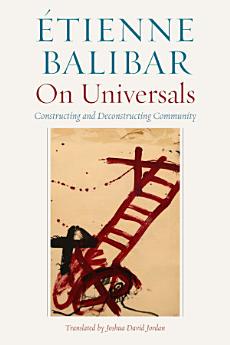
On Universals: Constructing and Deconstructing Community
この電子書籍について
In the contemporary quarrel of universals, Balibar shows, the stakes are no less than the future of our democracies. In dialogue with such philosophers as Alain Badiou, Judith Butler, and Jacques Rancière, he meticulously investigates the paradoxical processes by which the universal is constructed and deconstructed, instituted and challenged, in modern society. With critical rigor and keen historical insight, Balibar shows that every statement and institution of the universal—such as declarations of human rights—carry an exclusionary, particularizing principle within themselves and that every universalism immediately falls prey to countervailing universalisms. Always equivocal and plural, the universal is thus a persistent site of conflict within societies and within subjects themselves.
And yet, Balibar suggests, the very conflict of the universal—constituted as an ever-unfolding performative contradiction—also provides the emancipatory force needed to reinvigorate and reimagine contemporary politics and philosophy. In conversation with a range of thinkers from Marx, Freud, and Benjamin through Foucault, Derrida, and Scott, Balibar shows the power that resides not in the adoption of a single universalism but in harnessing the energies made available by claims to universality in order to establish a common answerable to difference.
著者について
Étienne Balibar (Author)
Étienne Balibar is Professor Emeritus of Moral and Political Philosophy at Université de Paris X–Nanterre; Distinguished Professor of Humanities at the University of California, Irvine; and Visiting Professor of French at Columbia University. His many books include Citizen Subject (Fordham, 2016); Equaliberty (Duke, 2014); We, the People of Europe? (Princeton, 2003); The Philosophy of Marx (Verso, new ed. 2017); and two important coauthored books, Race, Nation, Class (with Immanuel Wallerstein, Verso, 1988) and Reading Capital (with Louis Althusser and others, Verso, new ed. 2016).
Joshua David Jordan (Translator)
Joshua David Jordan translates twentieth- and twenty-first-century French prose and poetry. A specialist in the work of Henri Michaux, he teaches French literature and language at Fordham University. In 2015, he received a French Voices Award for his translation of David Lapoujade’s Aberrant Movements: The Philosophy of Gilles Deleuze.