About this ebook
Mention the word 'samurai' today, and popular imagination instantly conjures a solitary, noble swordsman wielding a razor-sharp katana, ready to decide the fate of kingdoms in a poetry of single combat beneath blooming cherry trees. It is a magnificent portrait, celebrated by Hollywood, literature, and modern martial arts. Yet from the perspective of authentic medieval military history, it is almost entirely fiction. The sword was never the primary weapon that carved empires or decided dynasties in feudal Japan. For over four centuries, the katana was merely a secondary sidearm—an emergency weapon of last resort, the medieval equivalent of an officer's service pistol. No major battle on Japanese soil was ever won by the sword.
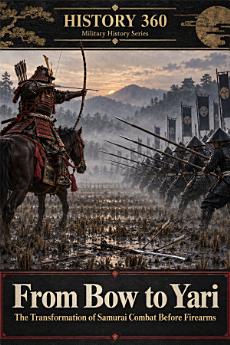
In this groundbreaking work of material and tactical history, History 360 shatters the romantic myths invented during the prolonged peace of the Edo period to reconstruct the gritty reality of Japanese warfare from the late Heian period through the height of the Sengoku Jidai. Long before massed infantry clashed in muddy rice paddies, the original twelfth-century samurai was an elite aristocratic horse archer. Bound by the warrior code of *kyūba no michi*—«the Way of the Horse and Bow»—these armored nobles fought from a distance, encased in boxy, lacquered *ō-yoroi* armors specifically engineered as mobile bastions to deflect enemy arrow storms.
Everything changed with the Mongol invasions of 1274 and 1281. Faced with disciplined continental phalanxes, massed crossbow volleys, and explosive gunpowder bombs, the Japanese ritual of individual vocal challenges collapsed in blood and fire. What followed was a profound four-century tactical revolution. Armies exploded in size; cavalry gave way to foot combat; devastating polearms like the *naginata* glaive and massive two-handed *nodachi* greatswords emerged to hamstring enemy mounts; and finally, the straight spear (*yari*) became the undisputed king of the battlefield. Thousands of disciplined peasant levies (*ashigaru*), operating five-meter pikes in coordinated, hedge-like walls, dismantled aristocratic equestrian warfare forever.