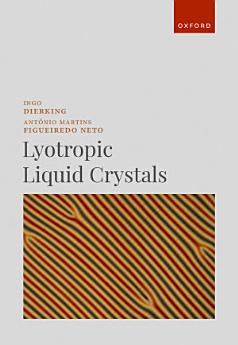
Lyotropic Liquid Crystals
ก.ค. 2024 · Oxford University Press
eBook
304
หน้า
family_home
มีสิทธิ์
info
เกี่ยวกับ eBook เล่มนี้
This book aims to review the field of lyotropic liquid crystals from amphiphilic to colloidal systems, bridging the gap between the two worlds of lyotropics and thermotropics by showing that many of the features observed in standard thermotropic liquid crystals may also be observed in lyotropic systems and vice versa. Indeed, for a long time, lyotropic liquid crystals have been overshadowed by their thermotropic counterparts, mainly due to the potential for application of the latter in the display industry. This picture has somewhat shifted over the last decade, with numerous novel lyotropic systems having been discovered and formulated, bringing to light their importance in wider scientific research. For example, the understanding of viruses forming self-assembled ordered phases has largely increased as mineral liquid crystals and clays have experienced a renaissance leading to fundamental research and work on structure formation in nanotechnology. Similarly, nano-rods, nano-wires, nanotubes and 2D materials like graphene oxide and others have been shown to exhibit liquid crystalline behaviour, which may be exploited in self-assembly, drug delivery or biosensors. Cellulose nanocrystals have become an important and popular field of research. The self-assembly of short chain DNA fragments has led to liquid crystal behaviour previously thought to be impossible. Chromonics were shown to exhibit fascinating physical properties, and the combination of active fluids with liquid crystals has opened a whole new field of research to be explored - 'living liquid crystals'.
This book aims to review the field of lyotropic liquid crystals from amphiphilic to colloidal systems, bridging the gap between the two worlds of lyotropics and thermotropics by showing that many of the features observed in standard thermotropic liquid crystals may also be observed in lyotropic s...
เกี่ยวกับผู้แต่ง
Ingo Dierking received his PhD at Clausthal University, Germany, in 1995 and then worked as a postdoc at the IBM TJ Watson Research Center, USA, before receiving a Humboldt fellowship for Chalmers University, Sweden. From 1999-2002 Dierking was a lecturer at Darmstadt University, Germany, before joining the University of Manchester where he is a Senior Lecturer. He has won several research awards, the GW Gray medal, the Cyril Hilsum medal and the Samsung Mid-career award and is currently the President of the International Liquid Crystal Society and a former Chair of the British Liquid Crystals Society. Antônio Martins Figueiredo Neto received his PhD at the University of São Paulo, Brazil, in 1981 and then worked as a postdoc at the Université Paris-Sud, France, from 1983 to 1985. In 1988 he became Full Professor of Physics at University of São Paulo. He is a member of the Brazilian Academy of Science and the State of São Paulo Academy of Science. He has published more than 200 papers in international journals and supervised more than 40 PhD and Master students.
Ingo Dierking received his PhD at Clausthal University, Germany, in 1995 and then worked as a postdoc at the IBM TJ Watson Research Center, USA, before receiving a Humboldt fellowship for Chalmers University, Sweden. From 1999-2002 Dierking was a lecturer at Darmstadt University, Germany, before ...
ให้คะแนน eBook นี้
แสดงความเห็นของคุณให้เรารับรู้
ข้อมูลในการอ่าน
สมาร์ทโฟนและแท็บเล็ต
ติดตั้งแอป Google Play Books สำหรับ Android และ iPad/iPhone แอปจะซิงค์โดยอัตโนมัติกับบัญชีของคุณ และช่วยให้คุณอ่านแบบออนไลน์หรือออฟไลน์ได้ทุกที่
แล็ปท็อปและคอมพิวเตอร์
คุณฟังหนังสือเสียงที่ซื้อจาก Google Play โดยใช้เว็บเบราว์เซอร์ในคอมพิวเตอร์ได้
eReader และอุปกรณ์อื่นๆ
หากต้องการอ่านบนอุปกรณ์ e-ink เช่น Kobo eReader คุณจะต้องดาวน์โหลดและโอนไฟล์ไปยังอุปกรณ์ของคุณ โปรดทำตามวิธีการอย่างละเอียดในศูนย์ช่วยเหลือเพื่อโอนไฟล์ไปยัง eReader ที่รองรับ