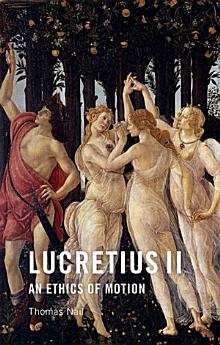
Lucretius II: An Ethics of Motion
févr. 2020 · Edinburgh University Press
E-book
240
Pages
family_home
Éligible
info
À propos de cet e-book
An ancient ethics for modern lifeDevelops an original ethics of motion for the 21st century from Lucretius' didactic poem De Rerum NaturaArgues uniquely that Lucretius had a distinct ethical theory from EpicurusPuts Lucretius in conversation with contemporary physics and new materialismLucretius II launch offerFind out where it all started: we're offering a free ebook of Lucretius I when you buy a copy of Lucretius II. Just add a copy of Lucretius II (paperback, hardback or ebook) and a Lucretius I ebook to your basket, and enter the code Lucretius2 when you check out.Visit the webpage for Lucretius IHuman suffering, the fear of death, war, poverty, ecological destruction and social inequality: almost 2,000 ago Lucretius proposed an ethics of motion as simple and stunning solution to these ethical problems. Thomas Nail argues that Lucretius was the first to locate the core of all these ethical ills in our obsession with stasis, our fear of movement and our hatred of matter. Instead of trying to transcend nature with our minds, escape it with our immortal souls and dominate it with our technologies, Lucretius was perhaps the first in the Western tradition to forcefully argue for a completely materialist, immanent and naturalistic ethics based on moving well with and as nature. If we want to survive and live well on this planet, Lucretius taught us, our best chance is not to struggle against nature but to embrace it and facilitate its movement.Lucretius II is the second installment in Thomas Nail's transformative reading of Lucretius' didactic poem De Rerum Natura, which can be read individually or as a trilogy. Lucretius I covered books 1 and 2 of De Rerum Natura and looked at Lucretius' ontology; this volume covers books 3 and 4 and Lucretius' ethics. The third and final volume will cover books 5 and 6."
An ancient ethics for modern lifeDevelops an original ethics of motion for the 21st century from Lucretius' didactic poem De Rerum NaturaArgues uniquely that Lucretius had a distinct ethical theory from EpicurusPuts Lucretius in conversation with contemporary physics and new materialismLucretius ...
À propos de l'auteur
Thomas Nail is Distinguished Scholar and Professor of Philosophy at the University of Denver. He is the award-winning author of eight prestigious University Press books which cover a wide range of topics including migration, borders, technology, digital media, history, science, economics, contemporary politics and climate change. His current research focuses on the influence of mobility on society and the arts in the 21st century. His work has been translated into ten major languages and cited across more than 20 academic disciplines.His published books are Marx in Motion: A New Materialist Marxism (Oxford University Press, 2020), Lucretius II: An Ethics of Motion (Edinburgh University Press, 2020), Theory of the Image (Oxford University Press, 2019), Being and Motion (Oxford University Press, 2018), Lucretius I: An Ontology of Motion (Edinburgh University Press, 2018), Theory of the Border (Oxford University Press, 2016), The Figure of the Migrant (Stanford University Press, 2015) and Returning to Revolution: Deleuze, Guattari, and Zapatismo (Edinburgh University Press, 2012).He also writes for Aeon: Ideas and Culture, The Huffington Post, Quartz, Pacific Standard: The Science of Society, History News Network and Monthly Review.
Thomas Nail is Distinguished Scholar and Professor of Philosophy at the University of Denver. He is the award-winning author of eight prestigious University Press books which cover a wide range of topics including migration, borders, technology, digital media, history, science, economics, contemp...
Donner une note à cet e-book
Dites-nous ce que vous en pensez.
Informations sur la lecture
Smartphones et tablettes
Installez l'application Google Play Livres pour Android et iPad ou iPhone. Elle se synchronise automatiquement avec votre compte et vous permet de lire des livres en ligne ou hors connexion, où que vous soyez.
Ordinateurs portables et de bureau
Vous pouvez écouter les livres audio achetés sur Google Play à l'aide du navigateur Web de votre ordinateur.
Liseuses et autres appareils
Pour lire sur des appareils e-Ink, comme les liseuses Kobo, vous devez télécharger un fichier et le transférer sur l'appareil en question. Suivez les instructions détaillées du Centre d'aide pour transférer les fichiers sur les liseuses compatibles.