About this ebook
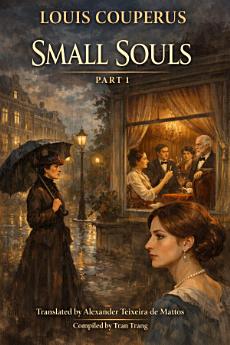
The story begins on a rainy evening when Dorine van Lowe arrives breathlessly at the house of her relatives, Karel and Cateau. This simple visit gradually unfolds into a broader portrait of family life. Through conversations, small gestures, and subtle observations, the narrative reveals the intricate connections among the members of the Van Lowe family—brothers, sisters, cousins, and in-laws whose lives remain closely intertwined despite differences in personality and outlook.
At the center of these relationships is the quiet tension surrounding Constance van Lowe, whose past decisions and return to family life continue to influence how others perceive her. Her presence awakens long-held opinions, whispered judgments, and unspoken resentments within the family circle. While outwardly maintaining politeness and social decorum, the characters reveal their inner fragility through gossip, pride, and emotional restraint.
The title Small Souls reflects one of the novel’s central ideas: how narrow feelings, social expectations, and personal pride can limit the way people understand one another. The characters are not villains, but ordinary individuals whose weaknesses—jealousy, insecurity, vanity, and fear of social opinion—shape their actions and relationships.
In Part 1, readers are introduced to the atmosphere of the Van Lowe household and the personalities that inhabit it. With careful psychological insight and quiet irony, the story portrays how seemingly minor emotions and family tensions can influence the lives of many people.
This opening part lays the foundation for a larger family drama, inviting readers to observe the delicate interplay between social respectability and the hidden emotional lives that exist beneath it.
Discover more
About the author
Louis Couperus (1863–1923) was one of the most important Dutch novelists and literary figures of the late nineteenth and early twentieth centuries. Born on June 10, 1863, in The Hague, Netherlands, he grew up in a family connected with the Dutch colonial administration in the East Indies (now Indonesia). His early life was influenced by both European aristocratic culture and colonial society, experiences that later shaped the themes and settings of many of his works.
Couperus began his literary career as a poet, but he soon gained widespread recognition as a novelist. His breakthrough came with the psychological novel Eline Vere (1889), which established him as a leading voice in Dutch literature. His writing is known for its refined style, deep psychological insight, and subtle exploration of social conventions, family relationships, and human weaknesses.
Many of Couperus’s novels examine the lives of upper-class families, revealing the emotional tensions, pride, gossip, and fragile sensibilities hidden beneath outward respectability. Works such as The Hidden Force, Old People and the Things That Pass, and the famous family cycle Small Souls demonstrate his skill in portraying complex characters and the quiet drama of everyday life.
In addition to novels, Couperus wrote travel writings, essays, and short stories. His works often blend realism with symbolism and psychological depth, making him one of the most distinctive literary voices in Dutch literature.
Louis Couperus died on July 16, 1923, in De Steeg, Netherlands. Today, he is remembered as a master of psychological fiction and a key figure in the development of modern Dutch literature.
Alexander Teixeira de Mattos (1865–1921) was a distinguished translator, journalist, and literary critic known for bringing many important European literary works to the English-speaking world. He was born on August 9, 1865, in Amsterdam, Netherlands, into a family of Portuguese-Jewish origin.
De Mattos became widely respected for his remarkable ability to translate complex literary texts with both accuracy and elegance. Fluent in several languages, including Dutch, French, and German, he played an important role in introducing English readers to continental European literature during the late nineteenth and early twentieth centuries.
Throughout his career, he translated numerous works by prominent authors such as Louis Couperus, Émile Zola, Maurice Maeterlinck, and Anatole France. His translations were praised for preserving the tone, atmosphere, and psychological depth of the original texts while making them accessible to a broader audience.
Alexander Teixeira de Mattos passed away on August 19, 1921. His contributions helped bridge linguistic and cultural gaps between European literatures and the English-speaking world, and he remains recognized as one of the notable literary translators of his time.
Tran Trang is the compiler of this edition. With a careful approach to literary presentation, Tran Trang has organized and prepared the text so that modern readers can easily access and appreciate the work. The compilation focuses on preserving the spirit and integrity of the original story while presenting it in a clear and readable form.
Through thoughtful editing and arrangement, Tran Trang aims to bring classic literature closer to contemporary audiences, allowing readers to experience the depth of the narrative, the richness of the characters, and the cultural atmosphere of the time in which the work was written. This effort helps ensure that the literary value of the original text continues to reach new generations of readers.