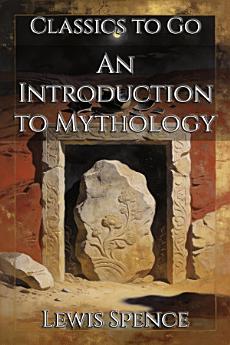
An Introduction to Mythology: Restored Classics to Go Edition

· Otbebookpublishing
Ebook
469
Pages
Eligible

About this ebook

Lewis Spence's introduction announces mythology as a modern, rapidly developing science, one shaped by folklore, comparative religion, and bold new theories that reinterpret familiar gods and symbols. Determined to make a confusing field intelligible, he offers an eclectic, commonsense guide that draws on major authorities such as Frazer, Lang, Hartland, and Elliot Smith while also using his own examples, tables, and definitions to help general readers and students alike. At its core, the book defines myth as a traditional story explaining the world, the gods, customs, and early human experience, while carefully distinguishing it from folklore, folk-tale, and legend. It treats religion as a concept impossible to define absolutely, then traces myth to primitive imagination, animism, fetishism, and an even earlier awe before mysterious natural forces. From there, Spence explores myths as survivals of ancient belief: a fisherman's legend hiding a thunder-god, Genesis reflecting Babylonian cosmogony, Japanese creation by Izanagi and Izanami, and world-making struggles in Iranian, Celtic, and Norse tradition. The survey continues through Aztec, Maya, K'iche', and Andean myths, where sacrifice, repeated destruction, maize, speech, and divine intention shape the birth of humanity and the cosmos. This edition has been fully restored with modern typesetting, custom cover design.
Lewis Spence's introduction announces mythology as a modern, rapidly developing science, one shaped by folklore, comparative religion, and bold new theories that reinterpret familiar gods and symbols. Determined to make a confusing field intelligible, he offers an eclectic, commonsense guide that...

Discover more

About the author

Lewis Spence was a Scottish writer, folklorist, poet, journalist, and one of the most prolific popular interpreters of myth and legend in the early twentieth century. Born in the Orkney Islands in 1874, he grew up with a deep sensitivity to the old stories, landscapes, and traditions of the North, and that fascination shaped a long career devoted to collecting, comparing, and explaining the myths of many cultures. Over the course of his life he produced an impressive body of work on folklore, ancient religions, Celtic tradition, the occult, and the imaginative power of traditional narrative, helping bring scholarly material to a wide general audience. His writing is marked by curiosity, energy, and a belief that myths are not merely relics of the past but living expressions of human hopes, fears, and values. He was especially interested in the shared patterns that connect stories across civilizations, and his work often explores creation, heroism, death, transformation, and the enduring mystery of the supernatural. For modern readers, Spence remains relevant because he invites us to see folklore and mythology as keys to cultural memory and to the ways societies make meaning. His legacy lies in making the study of myth accessible, vivid, and wide-ranging, and readers who enjoy legends, ancient beliefs, comparative mythology, Celtic lore, and the strange borderland between history and imagination will find him especially rewarding.

Lewis Spence was a Scottish writer, folklorist, poet, journalist, and one of the most prolific popular interpreters of myth and legend in the early twentieth century. Born in the Orkney Islands in 1874, he grew up with a deep sensitivity to the old stories, landscapes, and traditions of the North...

Rate this ebook

Tell us what you think.

Reading information

Smartphones and tablets
Install the Google Play Books app for Android and iPad/iPhone. It syncs automatically with your account and allows you to read online or offline wherever you are.
Laptops and computers
You can listen to audiobooks purchased on Google Play using your computer's web browser.
eReaders and other devices
To read on e-ink devices like Kobo eReaders, you'll need to download a file and transfer it to your device. Follow the detailed Help Center instructions to transfer the files to supported eReaders.