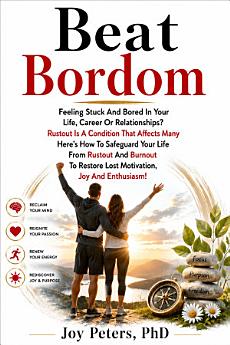
Beat Boredom: Feeling Stuck and Bored in Your Life, Career, or Relationships?
About this ebook
What it covers:
"The 8 Signs of Rust-Out" — each of the eight symptoms from your Chapter 1 symptom list, given its own colored icon badge (battery, loop, thought bubble, wrench, storm cloud, eye, hourglass, fast-forward) so it reads as a quick visual self-check, not just a wall of text
"Quick Test: Which One Is It?" — a three-way comparison strip distilling the rust-out vs. fatigue vs. depression distinction from the chapter into one scannable line per condition, including the professional-help nudge for the depression card
Needed info for all long-term relationships and friendships:
Why relationships rust the same way careers do — competence replacing engagement, connecting back to Ch. 1 and Ch. 4's unexamined routines
The motivation principle applied relationally — initiating connection before feeling curious, not after
Micro-risks for partnerships — the novel question, the novel activity, and the rhythm check
Micro-risks for friendships and family — reconnecting with faded (not fractured) relationships, applying the "ten-year-old test" in reverse to family members
Values clarification applied to relationships — running the energy audit quiz and "supposed to" audit specifically on relational obligations, outlines the pre- warning signs against dramatic overcorrection, and the core thesis: relationships rust and renew the same way, through compounding small acts, not single events
How To Build Your Anti-Rust Routine
This book promises relief (rust-out vs. depression/fatigue, the four root causes, action-precedes-motivation, micro-risks, the 90-day plan)
"Your engine isn't broken. It's just idle. Turn the key."
Discover more
About the author
Joy Peters is a health educator that is Harvard trained in mind-body Medicine, she is a retired traditional naturopathic doctor with a PhD in functional-medicine, she is also a certified nutritional consultant, certified personal fitness trainer and certified hypnotherapist with an undergraduate degree in psychology. Disclaimer: books are intended for educational purposes only and in no way establishes a patient/doctor relationship.