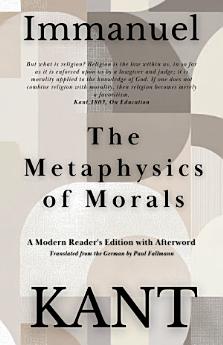
The Metaphysics of Morals: A New Reader's Edition

· The Collected Works of Immanuel Kant Book 22 · Theseus Press
Ebook
294
Pages
Eligible
17% price drop on Oct 28

About this ebook

Published in 1797 in Königsberg by Friedrich Nicolovius, The Metaphysics of Morals (Die Metaphysik der Sitten) is Immanuel Kant's final major work on practical philosophy, in which he presents a structured account of law and virtue grounded in the concept of freedom as the basis of right. This 1797 publication is not to be confused with his early 1785 work "Groundwork for the Metaphysics of Morals" which is a different book. Distinct from his earlier Critique of Practical Reason, this work is divided into two main parts: the Doctrine of Right (Rechtslehre), dealing with external laws and coercible duties in the civil realm, and the Doctrine of Virtue (Tugendlehre), treating internal moral duties and ethical self formation. It was conceived as the positive system of morals grounded in the pure principles laid out earlier in his critical ethics.

The Doctrine of Right sets out Kant's theory of juridical law, defining rights as conditions under which one's freedom can coexist with the freedom of others under a universal law. It includes his defense of property, contract, the state, and punishment, all rooted in the idea that legal obligations must be capable of external enforcement. In the Doctrine of Virtue, Kant turns to duties that cannot be imposed by force, such as beneficence, self respect, and moral cultivation, arguing that such duties arise from the internal command of reason. Throughout, Kant insists on a strict separation between legality and morality while maintaining that both derive from the autonomy of the will. This work completes his ethical project by laying out the juridical and ethical structure of human freedom in both public and private life.

Law is the inevitable end of Reason, and as such, is rooted in a priori principles native to the soul but not external experience, in other words, metaphysical. The imperative of virtue relies on inner compulsion, while the imperative of legality relies on an external compulsion. In his lifelong rage against the Empiricism of David Hume, Kant here builds a positive structure devoid of polemics. Kant's "Doctrine of Right" would inspire Hegel's 1820 Philosophy of Right, where he would develop a more strong legal theory and a more restrictive social contract.


Published in 1797 in Königsberg by Friedrich Nicolovius, The Metaphysics of Morals (Die Metaphysik der Sitten) is Immanuel Kant's final major work on practical philosophy, in which he presents a structured account of law and virtue grounded in the concept of freedom as the basis of right. This 17...

Discover more

About the author

Immanuel Kant (1724 to 1804) was a German philosopher who taught at the University of Königsberg. His books address knowledge, metaphysics, ethics, aesthetics, religion, natural science, and political thought; his major works include the three Critiques and the Groundwork of the Metaphysics of Morals.
Immanuel Kant (1724 to 1804) was a German philosopher who taught at the University of Königsberg. His books address knowledge, metaphysics, ethics, aesthetics, religion, natural science, and political thought; his major works include the three Critiques and the Groundwork of the Metaphysics of Mo...

Rate this ebook

Tell us what you think.

Reading information

Smartphones and tablets
Install the Google Play Books app for Android and iPad/iPhone. It syncs automatically with your account and allows you to read online or offline wherever you are.
Laptops and computers
You can listen to audiobooks purchased on Google Play using your computer's web browser.
eReaders and other devices
To read on e-ink devices like Kobo eReaders, you'll need to download a file and transfer it to your device. Follow the detailed Help Center instructions to transfer the files to supported eReaders.