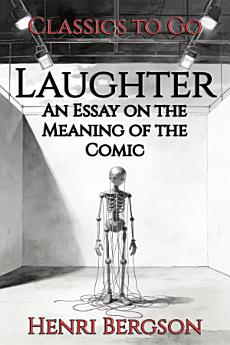
Laughter: Restored Classics to Go Edition
About this ebook
About the author
Henri Bergson was a French philosopher and essayist born in 1859 in Paris, and he became one of the most influential thinkers of the late nineteenth and early twentieth centuries. Trained in the classics and philosophy, he taught for many years, wrote with unusual clarity and elegance, and was eventually elected to the Académie Française, a sign of the esteem he earned in his own lifetime. His work helped redefine how readers think about time, consciousness, memory, creativity, and the movement of life itself, and he was widely celebrated for bringing philosophical ideas into a vivid, accessible form. Among his most important achievements was his penetrating study of humor and the social function of laughter, in which he showed that comedy often reveals the tension between living flexibility and mechanical rigidity. More broadly, Bergson argued that reality cannot be fully grasped by abstract analysis alone, because intuition, duration, and lived experience are essential to understanding human existence. These ideas remain strikingly relevant today in a world shaped by speed, routine, technology, and pressure to quantify everything, since Bergson reminds us to value inner life, spontaneity, and creativity. His influence reached beyond philosophy into literature, psychology, and modern thought, and his writing still speaks to readers interested in what makes life feel alive and meaningful. Readers who enjoy elegant philosophical prose, reflections on consciousness, and sharp insights into human behavior will find Bergson especially rewarding.