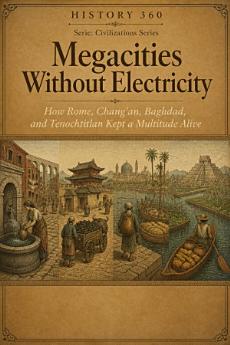
Megacities Without Electricity. How Rome, Chang’an, Baghdad, and Tenochtitlan Kept a Multitude Alive

· Miguel Muñoz
Ebook
120
Pages
Tools
Eligible

About this ebook

Rome, Chang’an, Baghdad, and Tenochtitlan were among the greatest cities of their ages, home to hundreds of thousands of people and, in Rome and Chang’an, perhaps close to a million. None of them had engines, motorized pumps, or a single electric light. So how did they work? Where did the water come from, who fed the crowds, who carried away the waste, how were fires kept in check, how did a stranger get in, and what did rulers do when the price of bread began to climb?


Megacities Without Electricity puts the same six questions to four very different worlds and lets the answers speak. Readers follow Frontinus, the water commissioner who hunted illegal pipes in imperial Rome; a Tang court that packed up and moved to Luoyang when the harvest failed; the water carriers and market inspectors of Abbasid Baghdad; and the canoes of Tenochtitlan hauling maize, fresh water, and even human waste across a salty lake in a city with no wheeled carts and no beasts of burden. Drawing on Roman law and letters, Tang statutes and poems, Arabic chronicles, the accounts of Spanish conquerors, Mexica codices, and archaeology, the book places emperors and caliphs beside bakers, porters, charcoal sellers, and firefighters.


This is neither a tale of rise and fall nor a claim that four distant cities were alike. The differences are the discovery: gravity or wells, state handouts or regulated markets, sewers or fertilizer, fire brigades or a sacred ritual that put out every flame in the valley. Rigorous, vivid, and surprisingly relevant, the book turns famous monuments into living organisms and invites every city dweller to ask a question we rarely consider until the lights go out: who keeps a multitude alive?
Rome, Chang’an, Baghdad, and Tenochtitlan were among the greatest cities of their ages, home to hundreds of thousands of people and, in Rome and Chang’an, perhaps close to a million. None of them had engines, motorized pumps, or a single electric light. So how did they work? Where did the water c...

Rate this ebook

Tell us what you think.

Reading information

Smartphones and tablets
Install the Google Play Books app for Android and iPad/iPhone. It syncs automatically with your account and allows you to read online or offline wherever you are.
Laptops and computers
You can listen to audiobooks purchased on Google Play using your computer's web browser.
eReaders and other devices
To read on e-ink devices like Kobo eReaders, you'll need to download a file and transfer it to your device. Follow the detailed Help Center instructions to transfer the files to supported eReaders.