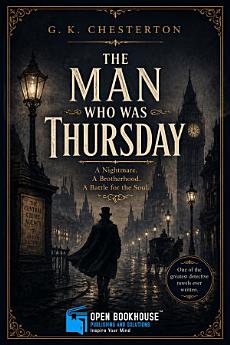
The Man Who Was Thursday: A Nightmare: A Philosophical Mystery of Anarchy, Order, and Hidden Power (Illustrated and Annotated Edition)
About this ebook
The Man Who Was Thursday is not merely a thriller. It is a philosophical nightmare disguised as a detective novel, where order and anarchy blur into something far more unsettling.
When poet-turned-detective Gabriel Syme infiltrates a secret council of anarchists, he discovers that nothing—and no one—is what they seem. Each revelation deepens the mystery, leading to a confrontation that challenges ideas of authority, freedom, evil, and God Himself.
Brilliantly witty, hauntingly symbolic, and startlingly modern, G. K. Chesterton’s masterpiece remains one of the most provocative novels ever written.
A must-read classic for lovers of mystery, philosophy, and timeless literature.
Discover more
About the author
Gilbert Keith Chesterton (1874–1936) was a renowned English writer, essayist, poet, and philosopher, born in London. He is celebrated for his sharp wit, imaginative storytelling, and profound insights into religion, society, and human nature.
Chesterton’s work spans a wide range of genres, including fiction, literary criticism, theology, and journalism. He is best known for creating the beloved fictional detective Father Brown, a humble Catholic priest who solves complex mysteries through his deep understanding of human psychology rather than conventional investigative methods.
Among his most famous works is The Man Who Was Thursday, a philosophical thriller that blends mystery with metaphysical inquiry, exploring themes of chaos, order, and the nature of reality. His essays and non-fiction writings are equally influential, often marked by his use of paradox to challenge conventional thinking and reveal deeper truths.
Chesterton’s writing style is distinctive for its clarity, humor, and intellectual depth. He had a remarkable ability to present complex ideas in an engaging and accessible manner, making his works both entertaining and thought-provoking.
Today, G. K. Chesterton is regarded as one of the most original and influential voices in English literature. His works continue to inspire readers with their rich imagination, moral insight, and enduring relevance.