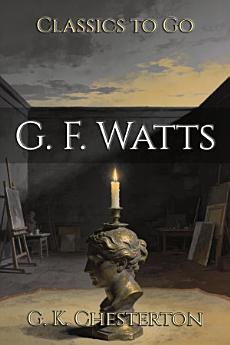
G. F. Watts: Restored Classics to Go Edition

· Otbebookpublishing
Ebook
13
Pages
Eligible

About this ebook

G. F. Watts emerges here as one of the great moral artists of the nineteenth century, a painter whose life, temper, and work seem inseparable from the Victorian age itself. Chesterton presents him as a serious, symbolic, and solitary figure, shaped by an era of doubt that still believed passionately in truth, duty, and the unity of existence. Against modern anti-didactic art, Watts stands for an older conviction that painting should serve life, ethics, and public purpose rather than aesthetic novelty alone. The book rejects easy labels, especially the claim that Watts is "Celtic," arguing instead that his art is English in gravity, disciplined in form, and rooted in concrete vision rather than dreaminess or escapism. Self-taught through Homer, Scott, the British Museum, and the Elgin marbles, he appears as an independent genius who never belonged neatly to Pre-Raphaelitism, Impressionism, or any school. His paintings seek universal symbols—earth, fire, sea, motherhood, death—so they can speak beyond their own time. Modest in person yet immense in ambition, Watts treats art as a moral law and aims to create work that can outlast the age that produced it. This edition has been fully restored with modern typesetting, custom cover design.
G. F. Watts emerges here as one of the great moral artists of the nineteenth century, a painter whose life, temper, and work seem inseparable from the Victorian age itself. Chesterton presents him as a serious, symbolic, and solitary figure, shaped by an era of doubt that still believed passionat...

Discover more

About the author

G. K. Chesterton, born in London in 1874, was one of the most distinctive and wide-ranging English writers of the early twentieth century: a journalist, critic, poet, novelist, biographer, and Christian apologist whose wit and intellectual energy made him a public voice as much as a literary one. Educated at St Paul's School and briefly at the Slade School of Fine Art, he began his career in publishing and journalism, where his essays quickly revealed the paradox-loving style that became his hallmark. Over the years he produced a remarkable body of work that included fiction, literary criticism, biography, essays, and religious writing, and he became known for defending ordinary life, common sense, and moral wonder against both cynicism and dogma. His studies of figures such as G. F. Watts show his gift for bringing art and ideas together with clarity and enthusiasm. Chesterton's writing often explores faith, freedom, justice, humility, and the hidden dignity of everyday existence, themes that still speak powerfully in an age of confusion and polarization. He remains significant not only for the breadth of his achievement but for his ability to combine humor with serious thought, inviting readers to see the world freshly and think more deeply about truth, tradition, and human nature. Readers who enjoy sparkling prose, lively argument, and books that are both intellectually stimulating and warmly humane will find Chesterton especially rewarding.
G. K. Chesterton, born in London in 1874, was one of the most distinctive and wide-ranging English writers of the early twentieth century: a journalist, critic, poet, novelist, biographer, and Christian apologist whose wit and intellectual energy made him a public voice as much as a literary one....

Rate this ebook

Tell us what you think.

Reading information

Smartphones and tablets
Install the Google Play Books app for Android and iPad/iPhone. It syncs automatically with your account and allows you to read online or offline wherever you are.
Laptops and computers
You can listen to audiobooks purchased on Google Play using your computer's web browser.
eReaders and other devices
To read on e-ink devices like Kobo eReaders, you'll need to download a file and transfer it to your device. Follow the detailed Help Center instructions to transfer the files to supported eReaders.