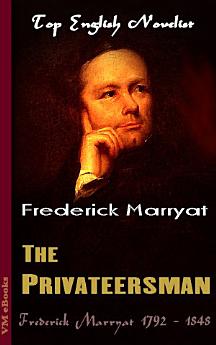
About this ebook
Published by VM eBook
Chapter One.
We cruise off Hispaniola—Capture of a French Ship—Continue our Cruise—Make a Nocturnal Attack upon a Rich Planter’s Dwelling—Are repulsed with Loss.
Chapter Two.
We are pursued by two Schooner-Privateers, and failing to escape them a terrible Contest ensues—Three Acts of a Murderous Naval Drama—We are worsted—Captain Weatherall is killed—I am plundered and wounded.
Chapter Three.
We are sent in, on board the Revenge, and treated with great cruelty—Are afterwards recaptured by the Hero privateer, and retaliate on the French—I am taken to the hospital at Port Royal, where I meet the French lady—Her savage exultation at my condition—She is punished by one of my comrades.
Chapter Four.
Sail for Liverpool in the Sally and Kitty—Fall in with a Gale—Boy overboard—Nearly drowned in attempting to save him—See the owners at Liverpool—Embark in the Dalrymple for the Coast of Africa—Arrive off Senegal.
Chapter Five.
In crossing the Bar at Senegal the boat is upset by a Tornado—We escape being devoured by Sharks only to be captured by the Natives—Are taken into the interior of the country, and brought before the Negro King, from whose wrath we are saved by the intercession of his female attendants.
Chapter Six.
I am given as a Slave to the old King’s Favourite, Whyna—Assist my young Mistress to make her Toilet—Hold frequent Conversations with her, and become strongly attached to her—My Hatred and Dread of the old King increase—He shoots a Man with Bird-arrows.
Chapter Seven.
I attend the King on a hunting Expedition—Chase of wild Animals—Whyna and I in great danger from a Tiger—Barbarity of the King to my young Mistress—I try to soothe her—I and my Companions are ransomed—Sad parting with Whyna—After an Encounter with a hostile People, we reach Senegal—Return to England.
Chapter Eight.
The Liverpool Ladies are very civil to me—I am admitted into good Society—Introduced to Captain Levee—Again sail to Senegal—Overhear a Conspiracy to seize the Ship by the Crew of a Slaver, but am enabled to defeat it—Am thanked and rewarded by the Owner—Take a Trip to London with Captain Levee—Stopped by Highwaymen on the Road—Put up at a Tavern—Dissipated Town Life—Remove to a genteel Boarding-House—Meet with a Government Spy—Return to Liverpool.
Chapter Nine.
I am put in command of the Sparrow-Hawk—Am directed to take four Jacobite Gentlemen secretly on board—Run with them to Bordeaux—Land them in safety—Dine with the Governor—Meet with the Widow of the French Gentleman I had unfortunately killed—Am insulted by her second Husband—Agree to fight with him—Sail down the River and prepare for Action.
Chapter Ten.
Captain Levee and I engage with the French Privateer—We come off victorious—My revenge against the French Lady—We take our Prize to Liverpool.
Chapter Eleven.
I cause myself to be dismissed from my Owner’s Service—Am arrested—Conveyed to London, and confined in the Tower—Am visited by a Romish Priest, and through his interference obtain my Liberation—Set off to Liverpool, and find my Owner and Captain Levee—Their surprise—Miss Trevannion.
Chapter Twelve.
I state my newly-awakened scruples as to the lawfulness of a Privateersman’s Life to Mr Trevannion, but nevertheless undertake another Cruise—Save a Youth from drowning, who he proves to be—Conflict with a French Privateer—Take her and deliver a Prize—Return to Liverpool—Resign the Command of the Sparrow-hawk, and agree to superintend Mr Trevannion’s Business.
Chapter Thirteen.
After staying a year with him, Mr Trevannion proposes to take me into Partnership, but I decline the offer from conscientious motives—Miss Trevannion treats me with unmerited coldness—This and her Father’s anger make me resolve to quit the House—What I overhear and see before my departure—The Ring.
Chapter Fourteen.
A Conspiracy, which ends satisfactorily to all Parties—Privateering is abandoned, and Captain Levee and Philip serve the King.
Chapter Fifteen.
We return to Liverpool—I have an interview with Miss Trevannion—Plutus interferes with Cupid, and I sail again for the coast of Africa.
Chapter Sixteen.
The Diamond-Mines, and what occurred there—I lose my friend Ingram, and another acquaintance, but they both leave me valuable Legacies.
Chapter Seventeen.
My adventures with the Indians, with what happened to the Portuguese Captain, my companion.
Discover more
About the author
Captain Frederick Marryat (10 July 1792 – 9 August 1848) was a British Royal Navy officer, novelist, and an acquaintance of Charles Dickens, noted today as an early pioneer of the sea story. He is now known particularly for the semi-autobiographical novel Mr Midshipman Easy and his children's novel The Children of the New Forest, and for a widely used system of maritime flag signalling, known as Marryat's Code.
Marryat was born in London, the son of Joseph Marryat, a "merchant prince" and member of Parliament, and his American wife Charlotte, née von Geyer. After trying to run away to sea several times, Marryat was permitted to enter the Royal Navy in 1806 as a midshipman on board HMS Imperieuse, a frigate commanded by Lord Cochrane (who would later serve as inspiration for both Marryat and other authors).
Marryat's time aboard the Imperieuse included action off the Gironde, the rescue of a fellow midshipman who had fallen overboard, captures of many ships off the Mediterranean coast of Spain, and the capture of the castle of Montgat. When the Imperieuse shifted to operations in the Scheldt, in 1809, Marryat contracted malaria, and returned to England on the 74-gun HMS Victorious.
From 1832 to 1835 Marryat edited The Metropolitan Magazine. He kept producing novels, his biggest success coming with Mr Midshipman Easy in 1836. He lived in Brussels for a year, travelled in Canada and the United States, then moved to London in 1839, where he was in the literary circle of Charles Dickens and others. He was in North America in 1837 when the Rebellion of that year in Lower Canada broke out, and served with the British forces in suppressing it.
Marryat was named a Fellow of the Royal Society in recognition of his invention and other achievements. In 1843 he moved to a small farm at Manor Cottage in Norfolk, where he died in 1848. His daughter Florence Marryat later became well known as a writer and actress. His son Francis Samuel Marryat completed his late novel The Little Savage.
Marryat's novels are characteristic of their time, with concerns of family connections and social status often overshadowing the naval action, but they are interesting as fictional renditions of the author's 25 years' of experience at sea. Much admired by men like Mark Twain, Joseph Conrad and Ernest Hemingway, they were among the first sea novels, serving as models for later works by C. S. Forester and Patrick O'Brian also set in the time of Nelson and telling of young men rising through the ranks through successes as naval officers. Along with his novels, Marryat was also known for his short writings on nautical subjects. These short stories, plays, pieces of travel journalism and essays appeared in The Metropolitan Magazine too, and were later published in book form as Olla Podrida. Marryat's 1839 Gothic novel The Phantom Ship contained The White Wolf of the Hartz Mountains, which includes the first female werewolf in a short story.
In the same year, 1839, Marryat published his Diary in America, a travelogue that reflects his criticisms of American culture and society. The book and the author were both subject to acts of violence, including the burning of the book and of Marryat's effigy in public.