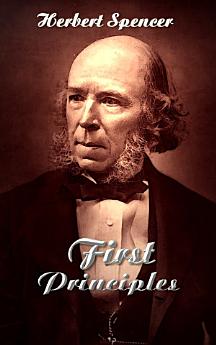
First Principles: Great Philosopher
Herbert Spencer
nov 2016 · Great Philosopher Boek 1 · 北戴河出版
E-boek
535
Pagina's
Tools
info
Over dit e-boek
This volume is the first of a series described in a prospectus originally distributed in March, 1860. Of that prospectus, the annexed is a reprint.
A SYSTEM OF PHILOSOPHY.
Mr. Herbert Spencer proposes to issue in periodical parts a connected series of works which he has for several years been preparing. Some conception of the general aim and scope of this series may be gathered from the following Programme.
FIRST PRINCIPLES.
PART I. The Unknowable.—Carrying a step further the doctrine put into shape by Hamilton and Mansel; pointing out the various directions in which Science leads to the same conclusions; and showing that in this united belief in an Absolute that transcends not only human knowledge but human conception, lies the only possible reconciliation of Science and Religion.
PART II. Laws of the Knowable.—A statement of the ultimate principles discernible throughout all manifestations of the Absolute—those highest generalizations now being disclosed by Science which are severally true not of one class of phenomena but of all classes of phenomena; and which are thus the keys to all classes of phenomena.
This volume is the first of a series described in a prospectus originally distributed in March, 1860. Of that prospectus, the annexed is a reprint.
A SYSTEM OF PHILOSOPHY.
Mr. Herbert Spencer proposes to issue in periodical parts a connected series of works which he has for several years been p...
Meer ontdekken
Over de auteur
Herbert Spencer (27 April 1820 – 8 December 1903) was an English philosopher, biologist, anthropologist, sociologist, and prominent classical liberal political theorist of the Victorian era.
Spencer developed an all-embracing conception of evolution as the progressive development of the physical world, biological organisms, the human mind, and human culture and societies. He was "an enthusiastic exponent of evolution" and even "wrote about evolution before Darwin did." As a polymath, he contributed to a wide range of subjects, including ethics, religion, anthropology, economics, political theory, philosophy, literature, astronomy, biology, sociology, and psychology. During his lifetime he achieved tremendous authority, mainly in English-speaking academia. "The only other English philosopher to have achieved anything like such widespread popularity was Bertrand Russell, and that was in the 20th century." Spencer was "the single most famous European intellectual in the closing decades of the nineteenth century" but his influence declined sharply after 1900: "Who now reads Spencer?" asked Talcott Parsons in 1937.
Spencer is best known for the expression "survival of the fittest", which he coined in Principles of Biology (1864), after reading Charles Darwin's On the Origin of Species. This term strongly suggests natural selection, yet as Spencer extended evolution into realms of sociology and ethics, he also made use of Lamarckism.
Herbert Spencer (27 April 1820 – 8 December 1903) was an English philosopher, biologist, anthropologist, sociologist, and prominent classical liberal political theorist of the Victorian era.
Spencer developed an all-embracing conception of evolution as the progressive development of the physical...
Dit e-boek beoordelen
Geef ons je mening.
Informatie over lezen
Smartphones en tablets
Installeer de Google Play Boeken-app voor Android en iPad/iPhone. De app wordt automatisch gesynchroniseerd met je account en met de app kun je online of offline lezen, waar je ook bent.
Laptops en computers
Via de webbrowser van je computer kun je luisteren naar audioboeken die je hebt gekocht op Google Play.
eReaders en andere apparaten
Als je wilt lezen op e-ink-apparaten zoals e-readers van Kobo, moet je een bestand downloaden en overzetten naar je apparaat. Volg de gedetailleerde instructies in het Helpcentrum om de bestanden over te zetten op ondersteunde e-readers.