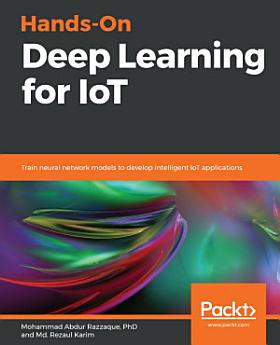
Hands-On Deep Learning for IoT: Train neural network models to develop intelligent IoT applications
About this ebook
- Understand how deep learning facilitates fast and accurate analytics in IoT
- Build intelligent voice and speech recognition apps in TensorFlow and Chainer
- Analyze IoT data for making automated decisions and efficient predictions
- Get acquainted with different neural network architectures and their suitability in IoT
- Understand how deep learning can improve the predictive power in your IoT solutions
- Capture and process streaming data for predictive maintenance
- Select optimal frameworks for image recognition and indoor localization
- Analyze voice data for speech recognition in IoT applications
- Develop deep learning-based IoT solutions for healthcare
- Enhance security in your IoT solutions
- Visualize analyzed data to uncover insights and perform accurate predictions
If you’re an IoT developer, data scientist, or deep learning enthusiast who wants to apply deep learning techniques to build smart IoT applications, this book is for you. Familiarity with machine learning, a basic understanding of the IoT concepts, and some experience in Python programming will help you get the most out of this book.
Discover more
About the author
Dr. Mohammad Abdur Razzaque is a senior lecturer in the School of Computing and Digital Technologies, Teesside University, UK. He has more than 14 years of research and development and teaching experience on distributed systems (Internet of Things, P2P networking, and cloud computing) as well as experience in cybersecurity. He is an expert in end-to-end (sensors-to-cloud) IoT solutions. He offers consultancy in the areas of IoT solutions and the use of machine learning techniques in businesses. He has successfully published more than 65 research papers in these areas. He holds a PhD in distributed systems (P2P wireless sensor networks, mobile ad hoc networks) from the School of Computer Science and Informatics, UCD, Dublin (2008).
Md. Rezaul Karim is a researcher, author, and data science enthusiast with a strong computer science background, coupled with 10 years of research and development experience in machine learning, deep learning, and data mining algorithms to solve emerging bioinformatics research problems by making them explainable. He is passionate about applied machine learning, knowledge graphs, and explainable artificial intelligence (XAI). Currently, he is working as a research scientist at Fraunhofer FIT, Germany. He is also a PhD candidate at RWTH Aachen University, Germany. Before joining FIT, he worked as a researcher at the Insight Centre for Data Analytics, Ireland. Previously, he worked as a lead software engineer at Samsung Electronics, Korea.