About this ebook
A nation can lose its sovereignty without losing a single battle. No invasion, no collapse, no declaration of war. Instead, power is shifting through the very systems designed to make our lives better. As Artificial Intelligence moves from a tool we use to the environment we inhabit, the traditional maps of geopolitics are being redrawn in code.
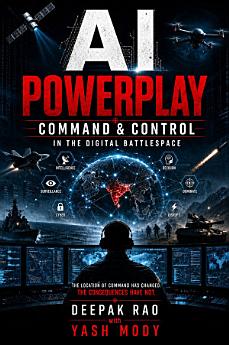
In AI Powerplay: Command & Control in the Digital Battlespace, the "Silent Coup" of the 21st century is finally unmasked. This is not a book about gadgets or trends; it is a tactical manual for understanding the new digital battlespace—a world where "Command and Control" is no longer about occupying territory, but about owning the architecture of thought and the infrastructure of decision-making.
What You Will Discover:
The Invisible Shift: How nations quietly surrender autonomy through digital dependency and "Sovereign AI" gaps.
The Weaponization of Everything: Why the next great conflict won’t be fought with kinetic weapons, but through the corruption of data and the capture of algorithmic flows.
The Architecture of Choice: An investigation into how AI shapes our reality, turning "independent" decisions into pre-designed outcomes.
The Diffusion of Accountability: Why power is becoming impossible to point at—and even harder to resist—as it dissolves into complex, distributed systems.
Everything looks normal. Everything feels the same. Except for one thing: control has moved.
From the rise of "Sovereign AI" to the erosion of the human decision-making loop, AI Powerplay provides a chillingly lucid guide for leaders, thinkers, and citizens who realize that in the age of automation, the most dangerous weapon is the one you don't even know you're using.
The battle for the future isn't coming. It’s already been integrated.
Discover more
Ratings and reviews

- Flag inappropriate
- Show review history

- Flag inappropriate

- Flag inappropriate
- Show review history
About the author
Deepak Rao is a commando trainer, close-quarters battle (CQB) specialist, and physician whose work operates at the intersection of combat science, cognitive conditioning, and systems-level strategy. Having trained elite units of the Indian Armed Forces, his expertise extends beyond physical warfare into the mechanics of decision-making, control, and operational dominance under pressure.
His frameworks and research have been referenced in international security contexts. Works such as the Encyclopaedia of Close Combat Ops are catalogued within United Nations library systems and held in institutional collections including the FBI and Interpol—reflecting their relevance to structured combat knowledge and tactical doctrine.
As an author, he has examined both the external and internal dimensions of conflict. His book Terrorism: A Comprehensive Analysis of World Terrorism, also catalogued in various National Libraries such as the National Library of Australia, contributes to global research discourse on asymmetric warfare and security systems.
In another book, Unfreak Your Mind – Rewire with Zen Psychology, he explores cognitive resilience, stress control, and the architecture of mental conditioning—extending his work into performance psychology and behavioural systems.
He is the creator of the POWERPLAY Series, a body of work examining how power evolves across physical, technological, and cognitive domains. His other complementary book SILICON POWERPLAY explores the rise of computational infrastructure, semiconductor dominance, and the strategic control of technological capability as a foundation of modern power.
Yash Mody is a technologist and innovation leader with over two decades of experience building and scaling large digital systems, with a strong focus on artificial intelligence, data platforms, and enterprise architecture. With more than 15 years in CTO roles, he has led the design and deployment of AI-driven ecosystems where models, data pipelines, and decision layers operate as core infrastructure.
His work spans AI integration, intelligent automation, and large-scale system design—translating theoretical capabilities into real-world applications under operational constraints. A holder of patents and contributor to research-led initiatives, he brings a practitioner’s perspective on how AI systems actually perform at scale.