Thoughts - Pensées
Blaise Pascal
Jan 2021 · Otbebookpublishing
Ebook
288
Pages
family_home
Eligible
info
About this ebook
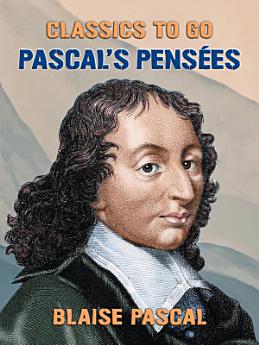
The Pensées ("Thoughts") is a collection of fragments written by the French 17th-century philosopher and mathematician Blaise Pascal. Pascal's religious conversion led him into a life of asceticism, and the Pensées was in many ways his life's work. It represented Pascal's defense of the Christian religion, and the concept of "Pascal's wager" stems from a portion of this work.
The Pensées ("Thoughts") is a collection of fragments written by the French 17th-century philosopher and mathematician Blaise Pascal. Pascal's religious conversion led him into a life of asceticism, and the Pensées was in many ways his life's work. It represented Pascal's defense of the Christian...
About the author
Blaise Pascal (1623-1662) was a French mathematician, physicist, inventor, philosopher, and writer whose intellectual legacy transcends disciplines. Born in Clermont-Ferrand, Pascal displayed prodigious talent from a young age, contributing to the fields of geometry and probability theory by his teens. His invention of the mechanical calculator, the Pascaline, marked a significant leap in computational technology, prefiguring the digital age.Pascal's life was marked by intense intellectual exploration and personal turmoil. A devout Catholic, his religious conversion in 1654 led him to join the Jansenist movement, a controversial sect within Catholicism that emphasized predestination and human depravity. This affiliation embroiled him in theological disputes, most notably with the Jesuits, which he addressed through his incisive and satirical "Provincial Letters." These letters not only defended Jansenism but also critiqued the moral laxity of the Jesuits, showcasing Pascal's sharp wit and rhetorical prowess.His philosophical musings on human nature, faith, and reason have had a lasting impact, influencing existentialists like Søren Kierkegaard and modern thinkers such as Albert Camus. Pascal's famous "wager" argument, positing that belief in God is a rational bet, continues to provoke debate among theologians and philosophers.Despite his relatively short life, Pascal's interdisciplinary genius and his ability to intertwine scientific rigor with profound spiritual inquiry make him a figure of enduring fascination. His work remains a testament to the power of intellectual curiosity and the quest for truth in all its forms.
Blaise Pascal (1623-1662) was a French mathematician, physicist, inventor, philosopher, and writer whose intellectual legacy transcends disciplines. Born in Clermont-Ferrand, Pascal displayed prodigious talent from a young age, contributing to the fields of geometry and probability theory by his ...
Rate this ebook
Tell us what you think.
Reading information
Smartphones and tablets
Install the Google Play Books app for Android and iPad/iPhone. It syncs automatically with your account and allows you to read online or offline wherever you are.
Laptops and computers
You can listen to audiobooks purchased on Google Play using your computer's web browser.
eReaders and other devices
To read on e-ink devices like Kobo eReaders, you'll need to download a file and transfer it to your device. Follow the detailed Help Center instructions to transfer the files to supported eReaders.