About this ebook
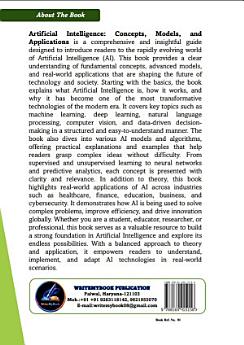
The text begins with a clear explanation of the core concepts of Artificial Intelligence, including its meaning, scope, history, and significance in the modern digital era. It traces the evolution of AI from its early beginnings to its current role in transforming industries such as education, healthcare, finance, transportation, and communication. The introductory chapters establish a strong conceptual base, enabling readers to understand how intelligent systems simulate human thinking and decision-making processes.
Moving forward, the book explores various AI models and techniques that form the backbone of intelligent systems. It covers essential topics such as machine learning, deep learning, neural networks, natural language processing, expert systems, and robotics. Each model is explained in a structured and accessible manner, highlighting its working principles, advantages, and limitations. The emphasis is on developing a conceptual clarity that allows readers to connect theory with real-world implementation.
A key strength of this book lies in its focus on applications of Artificial Intelligence across diverse domains. It demonstrates how AI technologies are being used to solve complex problems, enhance productivity, and improve decision-making. From smart education systems and virtual assistants to predictive analytics and autonomous systems, the book provides relevant and contemporary examples that showcase the transformative power of AI.
In addition, the book addresses ethical considerations, challenges, and future prospects of Artificial Intelligence. It encourages readers to critically analyze issues such as data privacy, bias, accountability, and the societal impact of intelligent technologies. This perspective ensures that readers not only understand how AI works but also recognize its broader implications.
Written in a clear, professional, and reader-friendly style, this book aims to bridge the gap between theoretical knowledge and practical application. It serves as an essential guide for anyone interested in understanding the concepts, exploring the models, and discovering the wide-ranging applications of Artificial Intelligence in today’s rapidly evolving technological landscape.
Discover more
Ratings and reviews

- Flag inappropriate
About the author
Artificial Intelligence: Concepts, Models, and Applications presents a clear and insightful exploration of AI, bridging foundational theories with modern innovations in an accessible manner. The book equips readers with a strong conceptual understanding while guiding them through practical models that shape intelligent systems today. It highlights real-world applications across diverse sectors, demonstrating how AI enhances decision-making, efficiency, and problem-solving. With a balanced focus on technical depth and clarity, it serves as a valuable resource for both beginners and advanced learners. The content is carefully structured to encourage analytical thinking and conceptual clarity. It also addresses ethical concerns and future challenges, ensuring a holistic perspective of AI. Designed with a professional yet reader-friendly approach, the book supports academic learning as well as practical implementation. It inspires readers to explore the evolving landscape of intelligent technologies with confidence. By integrating theory, models, and applications, it creates a meaningful learning experience. This book stands as a comprehensive guide for understanding and applying Artificial Intelligence in today’s digital world.