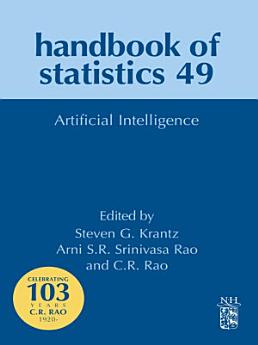
Artificial Intelligence

· ·
· Handbook of Statistics 49. liburua · Elsevier
Liburu elektronikoa
420
orri
Egokia

Liburu elektroniko honi buruz

Artificial Intelligence, Volume 49 in the Handbook of Statistics series, highlights new advances in the field, with this new volume presenting interesting chapters on a variety of timely topics. Chapters in this new release include AI Teacher-Student based Adaptive Structural Deep Learning Model and Its Estimating Uncertainty of Image Data, Machine-derived Intelligence: Computations Beyond the Null Hypothesis, Object oriented basis of artificial intelligence methodologies I in Judicial Systems in India, Artificial Intelligence in Systems Biology, Machine-Learning in Geometry and Physics, Innovation and Machine Learning: Crowdsourcing Open-Source Natural Language Processing (NLP) Algorithms to Advance Public Health Surveillance, and more. Other chapters cover Learning and identity testing of Markov chains, Data privacy for machine learning and statistics, and The interface between AI and Mathematics. - Provides the authority and expertise of leading contributors from an international board of authors - Presents the latest release in the Handbook of Statistics series - Includes the latest information on Artificial Intelligence
Artificial Intelligence, Volume 49 in the Handbook of Statistics series, highlights new advances in the field, with this new volume presenting interesting chapters on a variety of timely topics. Chapters in this new release include AI Teacher-Student based Adaptive Structural Deep Learning Model ...

Ezagutu gehiago

Egileari buruz

Arni S.R. Srinivasa Rao works in pure mathematics, applied mathematics, probability, artificial intelligence and applications in medicine. He developed the concept of “Exact Deep Learning Machines, which can provide designs for accurate predictions without any uncertainty. He had edited these handbooks jointly with renowned statistician Dr. C. R. Rao. He is a Professor at the Medical College of Georgia, Augusta University, U.S.A., and the Director of the Laboratory for Theory and Mathematical Modeling housed within the Division of Infectious Diseases, Medical College of Georgia, Augusta, U.S.A. Previously, Dr. Rao conducted research and/or taught at the Mathematical Institute, University of Oxford (2003, 2005-07), Indian Statistical Institute (1998-2002, 2006-2012), Indian Institute of Science (2002-04), University of Guelph (2004-06). Until 2012, Dr. Rao held a permanent faculty position at the Indian Statistical Institute. He has won the Heiwa-Nakajima Award (Japan) and Fast Track Young Scientists Fellowship in Mathematical Sciences (DST, New Delhi). Dr. Rao also proved a major theorem in stationary population models, such as, Rao’s Partition Theorem inPopulations, Rao-Carey Theorem in stationary populations, and developed mathematical modeling-based policies for the spread of diseases like HIV, H5N1, COVID-19, etc. He developed a new set of network models for understanding avian pathogen biology on grid graphs (these were called chicken walk models), AI Models for COVID-19, and received wide coverage in the science media. Dr. Rao is an elected Fellow of ISMMACS (Indian Society for Mathematical Modeling and Computer Simulation), and ISPS (Indian Society for Probability and Statistics). He developed concepts such as “Multilevel Contours within a bundle of Complex Number Planes.

Prof. Steven G. Krantz works at the Department of Mathematics, Washington University, St. Louis, Missouri, United States.
Arni S.R. Srinivasa Rao works in pure mathematics, applied mathematics, probability, artificial intelligence and applications in medicine. He developed the concept of “Exact Deep Learning Machines, which can provide designs for accurate predictions without any uncertainty. He had edited these han...

Baloratu liburu elektroniko hau

Eman iezaguzu iritzia.

Irakurtzeko informazioa

Telefono adimendunak eta tabletak
Instalatu Android eta iPad/iPhone gailuetarako Google Play Liburuak aplikazioa. Zure kontuarekin automatikoki sinkronizatzen da, eta konexioarekin nahiz gabe irakurri ahal izango dituzu liburuak, edonon zaudela ere.
Ordenagailu eramangarriak eta mahaigainekoak
Google Play-n erositako audio-liburuak entzuteko aukera ematen du ordenagailuko web-arakatzailearen bidez.
Irakurgailu elektronikoak eta bestelako gailuak
Tinta elektronikoa duten gailuetan (adibidez, Kobo-ko irakurgailu elektronikoak) liburuak irakurtzeko, fitxategi bat deskargatu beharko duzu, eta hura gailura transferitu. Jarraitu laguntza-zentroko argibide xehatuei fitxategiak irakurgailu elektroniko bateragarrietara transferitzeko.