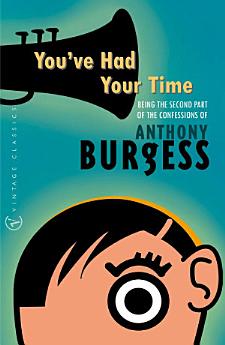
You've Had Your Time
About this ebook
There is the éclat of A Clockwork Orange (and the consequent calls for Burgess to comment on violent atrocities), the huge success - after a long barren period - of Earthly Powers. There is a terrifying first marriage, his description of which is both painful and funny. His second marriage - and the discovery that he has a four-year-old son - changes his life dramatically, and he and Liana escape to the Mediterranean, for an increasingly European life. With this marriage comes the triumphant rebirth of sex, creative energy and travel - to America, to Australia and all over Europe.
Discover more
Ratings and reviews
About the author
Anthony Burgess was born in Manchester in 1917 and educated at Xaverian College and Manchester University. He served in the British army from 1940 to 1946 and was a schoolteacher in England before becoming a colonial education officer in 1954. His Malayan trilogy of novels and a history of English literature were published while he was living in Malaya and Brunei.
He became a full-time writer in 1959 and achieved a worldwide reputation as one of the most versatile novelists of his day. His writings include biographies of Shakespeare and Hemingway, critical studies of James Joyce, stage plays, and two volumes of autobiography. His work as a composer and librettist includes the Broadway musical, Cyrano, and Blooms of Dublin, an operetta based on Joyce's Ulysses.
His 33 novels continue to be published all over the world. They include A Clockwork Orange, Nothing Like the Sun, The Complete Enderby, Earthly Powers, Napoleon Symphony, and Beard's Roman Women, a collaboration with the photographer David Robinson.
Anthony Burgess died in London in 1993.