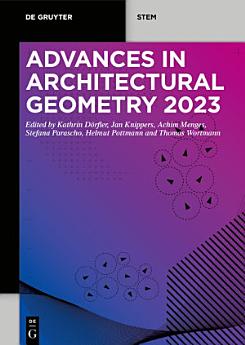
Advances in Architectural Geometry 2023
Kathrin Dörfler · Jan Knippers · Achim Menges · Stefana Parascho · Helmut Pottmann · Thomas Wortmann
oct. 2023 · Walter de Gruyter GmbH & Co KG
Carte electronică
484
Pagini
Instrumente
info
Despre această carte electronică
This book contains 34 technical papers presented at the Advances in Architectural Geometry Conference held in Stuttgart 2023.
Modern geometric computing increasingly plays a role in modeling environments and processing sensing information, providing a variety of tools for the efficient design, analysis, and manufacturing of complex shapes. The research area of architectural geometry (AG) has emerged at the common border of architecture, applied geometry, computational design, mathematics, and manufacturing. This book presents the state of the art of research in AG.
This book contains 34 technical papers presented at the Advances in Architectural Geometry Conference held in Stuttgart 2023.
Modern geometric computing increasingly plays a role in modeling environments and processing sensing information, providing a variety of tools for the efficient design, a...
Descoperă mai multe
Despre autor
1. Kathrin Dörfler is an architect, researcher, and educator in computational design and robotic fabrication. She holds a master's degree in architecture from TU Vienna and a PhD in digital fabrication from ETH Zurich. In 2019, Kathrin joined the School of Engineering and Design at the Technical University of Munich as a tenure-track professor to set up a research group for digital fabrication in the Department of Architecture. Her group's research interests lie at the intersection of collaborative fabrication processes, on-site robotics, additive manufacturing, and fabrication-aware design.
2. Jan Knippers is a structural engineer and since 2000 head of the Institute for Building Structures and Structural Design (ITKE) at the University of Stuttgart. His interest is in innovative and resource-efficient structures at the intersection of research and development and practice. From 2014 to 2019 Jan Knippers was coordinator of the collaborative research centre TRR141 „Biological Design and Integrative Structures“ at the Universities of Stuttgart, Tübingen and Freiburg. Since 2019 he is Deputy Director of the Cluster of Excellence “Integrative Computational Design and Construction” and currently dean of the Faculty of Architecture and Urban Planning.
3. Achim Menges is a registered architect in Frankfurt and full professor at Stuttgart University, where he is the founding director of the Institute for Computational Design and Construction (ICD) and the director of the Cluster of Excellence Integrative Computational Design and Construction for Architecture (IntCDC). In addition, he has been Visiting Professor in Architecture at Harvard University’s Graduate School of Design and held multiple other visiting professorships in Europe and the US. The focus of his practice and research is on interdisciplinary and integrative approaches to computational design and construction.
4. Stefana Parascho is a researcher, architect, and educator whose work lies at the intersection of architecture, digital fabrication and computational design. She is currently an Assistant Professor at EPFL where she founded the Lab for Creative Computation (CRCL). Through her research, she has explored multi-robotic fabrication methods and their relationship to design. Before joining EPFL, Stefana was an Assistant Professor at Princeton University, where she led the CREATE Lab Princeton. She completed her doctorate in 2019 at ETH Zurich, Gramazio Kohler Research. Previously, she received her Diploma in Architectural Engineering from the University of Stuttgart and worked with DesignToProduction Stuttgart and Knippers Helbig Advanced Engineering.
5. Helmut Pottmann is a professor of Applied Mathematics and Computational Science at King Abdullah University of Science and Technology (KAUST) and founding director of the Visual Computing Center at KAUST. He has had faculty positions in the US and in Germany and has been a Professor of Applied Geometry at TU Vienna since 1992. His research interests are in Applied Geometry, Visual Computing and most recently in Geometric Computing for Architecture and Manufacturing. He has co-authored a book and influential papers on Architectural Geometry and is a co-founder of the AAG conference series. Helmut Pottmann is a Fellow of SIAM and recipient of the Eurographics Outstanding Technical Contributions Award.
6. Thomas Wortmann directs the Chair for Computing in Architecture at the Institute of Computational Design and Construction (ICD/CA) at the University of Stuttgart. He holds a Master of Architecture from University of Kassel, a Master of Science in Design and Computation from MIT, and a PhD in Architecture and Sustainable Design from Singapore University of Technology and Design. He researches the application of artificial intelligence (AI) methods—such as AI reasoning, AI planning, supervised learning, optimization, and multi-variate visualization—in architectural design and construction processes and leads the development of Opossum, a machine learning-based optimization tool that has been downloaded over 10.000 times.
1. Kathrin Dörfler is an architect, researcher, and educator in computational design and robotic fabrication. She holds a master's degree in architecture from TU Vienna and a PhD in digital fabrication from ETH Zurich. In 2019, Kathrin joined the School of Engineering and Design at the Technical...
Evaluează cartea electronică
Spune-ne ce crezi.
Informații despre lectură
Smartphone-uri și tablete
Instalează aplicația Cărți Google Play pentru Android și iPad/iPhone. Se sincronizează automat cu contul tău și poți să citești online sau offline de oriunde te afli.
Laptopuri și computere
Poți să asculți cărțile audio achiziționate pe Google Play folosind browserul web al computerului.
Dispozitive eReader și alte dispozitive
Ca să citești pe dispozitive pentru citit cărți electronice, cum ar fi eReaderul Kobo, trebuie să descarci un fișier și să îl transferi pe dispozitiv. Urmează instrucțiunile detaliate din Centrul de ajutor pentru a transfera fișiere pe dispozitivele eReader compatibile.