Meer oor hierdie e-boek
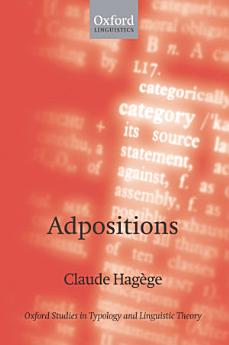
This pioneering study is based on an analysis of over 200 languages, including African, Amerindian, Australian, Austronesian, Indo-European and Eurasian (Altaic, Caucasian, Chukotko-Kamchatkan, Dravidian, Uralic), Papuan, and Sino-Tibetan. Adpositions are an almost universal part of speech. English has prepositions; some languages, such as Japanese, have postpositions; others have both; and yet others kinds that are not quite either. As grammatical tools they mark the relationship between two parts of a sentence: characteristically one element governs a noun or noun-like word or phrase while the other functions as a predicate. From the syntactic point of view, the complement of an adposition depends on a head: in this last sentence, for example, a head is the complement of on while on a head depends on depends and on is the marker of this dependency. Adpositions lie at the core of the grammar of most languages, their usefulness making them recurrent in everyday speech and writing. Claude Hagège examines their morphological features, syntactic functions, and semantic and cognitive properties. He does so for the subsets both of adpositions that express the relations of agent, patient, and beneficiary, and of those which mark space, time, accompaniment, or instrument. Adpositions often govern case and are sometimes gradually grammaticalized into case. The author considers the whole set of function markers, including case, that appear as adpositions and, in doing so, throws light on processes of morphological and syntactic change in different languages and language families. His book will be welcomed by typologists and by syntacticians and morphologists of all theoretical stripes.
This pioneering study is based on an analysis of over 200 languages, including African, Amerindian, Australian, Austronesian, Indo-European and Eurasian (Altaic, Caucasian, Chukotko-Kamchatkan, Dravidian, Uralic), Papuan, and Sino-Tibetan. Adpositions are an almost universal part of speech. Engli...
Meer oor die skrywer
Claude Hagège has been Professor of Linguistic Theory at the Collège de France since 1988 where his research has focussed on language and its relation to culture. His book L'homme de paroles (Fayard 1985, new edn 1996) won the Prix de l'Académie Française and was translated into English in 1990 under the title The Dialogic Species (Columbia University Press). His other books include La grammaire générative (PUF 1976), translated into English in 1981 under the title Critical reflections on generative grammar (Jupiter Press); Le souffle de la langue (Odile Jacob 1992); The Language Builder: An Essay on the Human Signature in Linguistic Morphogenesis (John Benjamins 1993); and Combat pour le français (Odile Jacob 2006). He was made a Chevalier de la Légion d'honneur in 1998 and promoted to Officer in 2007.
Claude Hagège has been Professor of Linguistic Theory at the Collège de France since 1988 where his research has focussed on language and its relation to culture. His book L'homme de paroles (Fayard 1985, new edn 1996) won the Prix de l'Académie Française and was translated into English in 1990 u...
Gradeer hierdie e-boek
Sê vir ons wat jy dink.
Lees inligting
Slimfone en tablette
Installeer die Google Play Boeke-app vir Android en iPad/iPhone. Dit sinkroniseer outomaties met jou rekening en maak dit vir jou moontlik om aanlyn of vanlyn te lees waar jy ook al is.
Skootrekenaars en rekenaars
Jy kan jou rekenaar se webblaaier gebruik om na oudioboeke wat jy op Google Play gekoop het, te luister.
E-lesers en ander toestelle
Om op e-inktoestelle soos Kobo-e-lesers te lees, moet jy ’n lêer aflaai en dit na jou toestel toe oordra. Volg die gedetailleerde hulpsentrumaanwysings om die lêers na ondersteunde e-lesers toe oor te dra.